Web Engagement Studio Unifying the Creation Experience

EXECUTIVE SUMMARY

At Salesmanago, we faced a major scalability hurdle: maintaining over 10 fragmented creators (pop-ups, landing pages, forms, etc.). This fragmentation caused significant tech debt and user confusion. As the Lead Product Designer, I spearheaded the unification of these tools into a single, powerful ecosystem: the Web Engagement Studio.

YEAR

2024-2025

ROLE

UX/UI
Product Designer

SERVICES

Product Strategy, Design Systems, Enterprise UI/UX Design

The Challenge

Tech Debt & Cognitive Overload

Business Pain:
Maintaining 10 separate infrastructures was resource-heavy and blocked the roadmap for new features. The Custom Design department was overwhelmed with basic requests because clients couldn't solve simple design needs within the legacy editors.

User Pain:
"Cognitive Overload"—users had to learn 10 different interfaces and logics. This learning curve hindered the adoption of advanced features.

The Goal: Consolidate 10 tools into 1 stable engine, reduce Custom Design tickets by 60%, and empower users to be self-sufficient.

The Process

Bridging Design & Engineering - From Chaos to Strategy

Before diving into pixels, I led a rigorous preparation phase to ensure the new Studio would be both technically sound and business-aligned.

Audit & Aggregation:
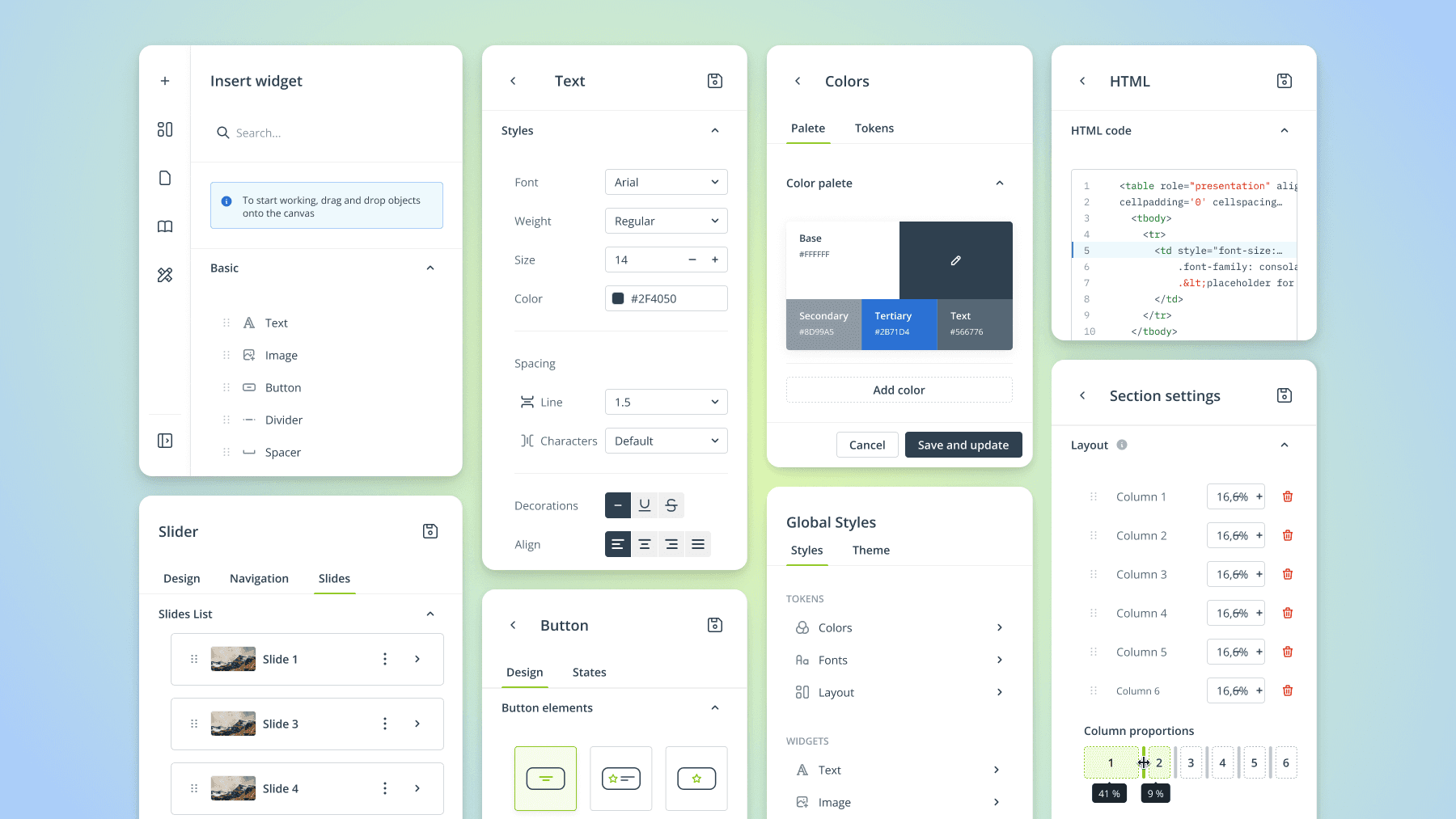
I started by aggregating all requests from the Custom Design department and analyzing client pain points. We conducted a functional audit of all 10+ legacy creators to identify overlaps, feature gaps, and essential "must-haves" for the new unified engine.

Technical & Market Research:
Together with the development team, we performed a deep technical feasibility study focusing on backward compatibility. Simultaneously, I conducted competitive research to ensure our new solution met the latest industry trends and user expectations.

The "Product Triad" Collaboration:
I worked in a core 3-person team (Product Designer, PO, and Tech Lead) to finalize the architecture. This collaboration ensured that our "Minimum Viable Plan" was balanced across design, business goals, and engineering constraints.

Iterative Design & Engineering Sync:
Once the architecture was approved by stakeholders, I moved to low-fidelity wireframes. Every section was developed iteratively and reviewed by the dev team to prevent technical roadblocks early on.

Design System as a Single Source of Truth:
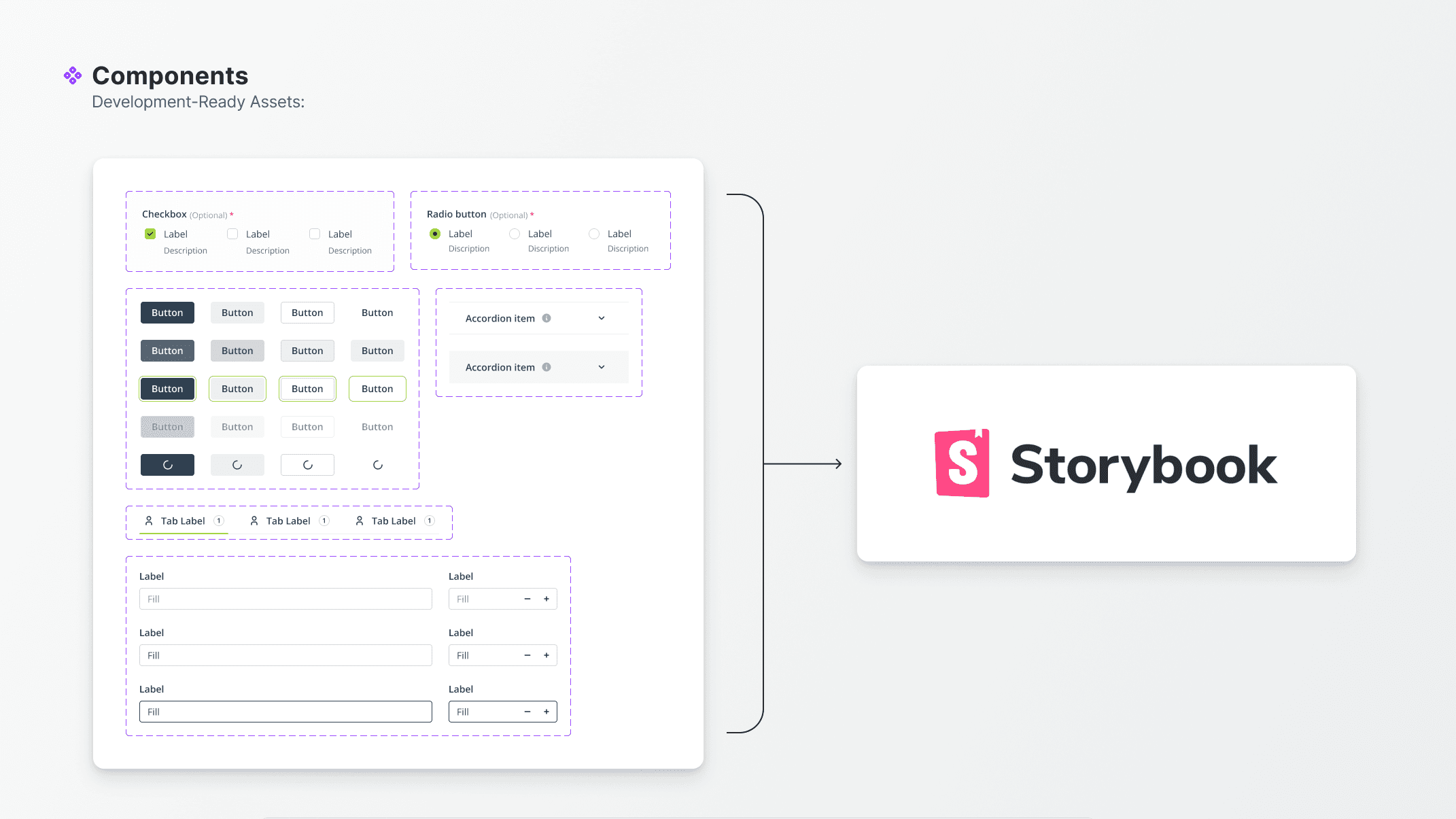
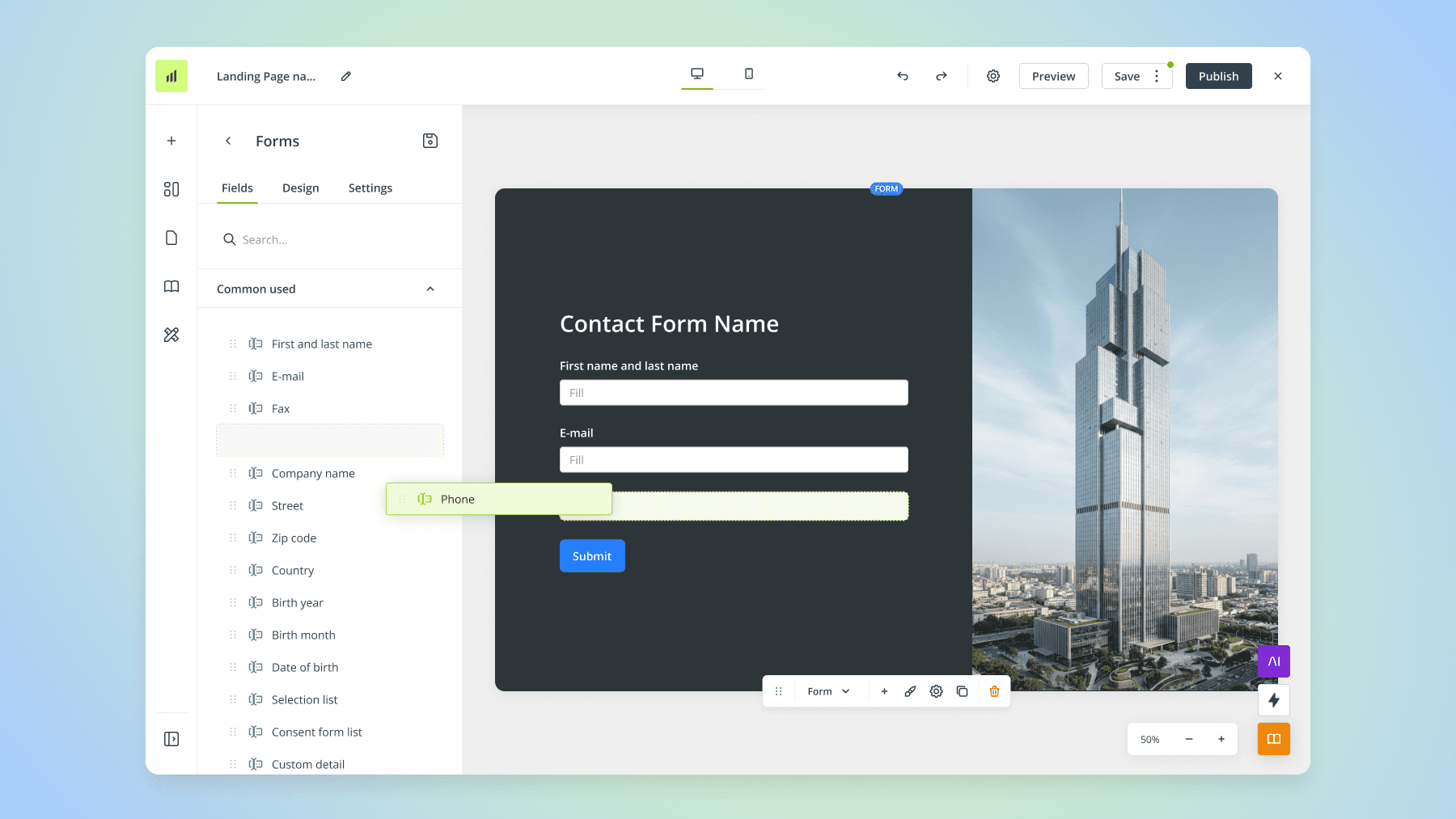
Every component was built and synced with Storybook from day one. This technical "bridge" allowed us to maintain 100% UI consistency and significantly speed up the hand-off process.
Validation

Data-Driven Refinement

Alpha Testing:
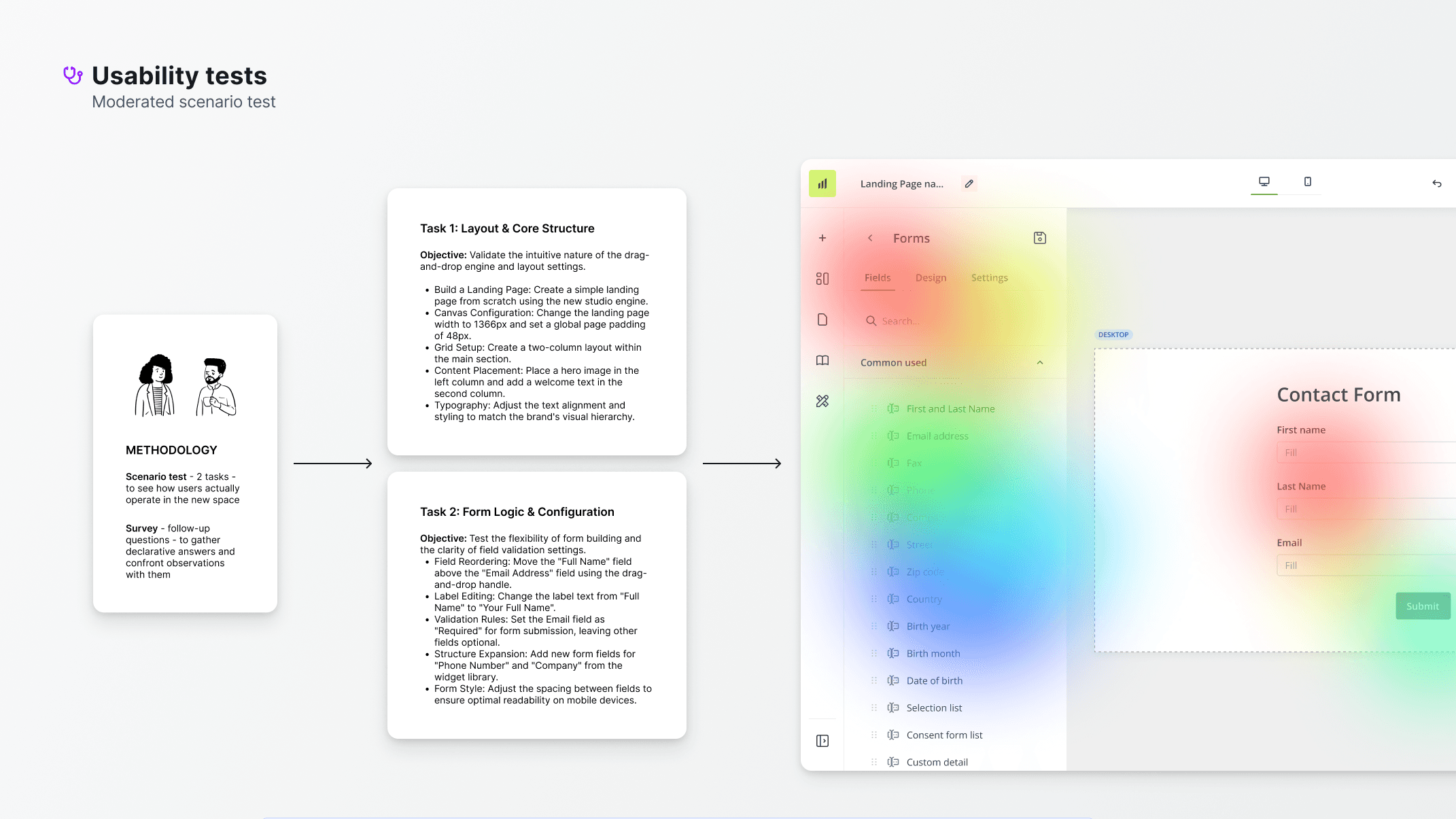
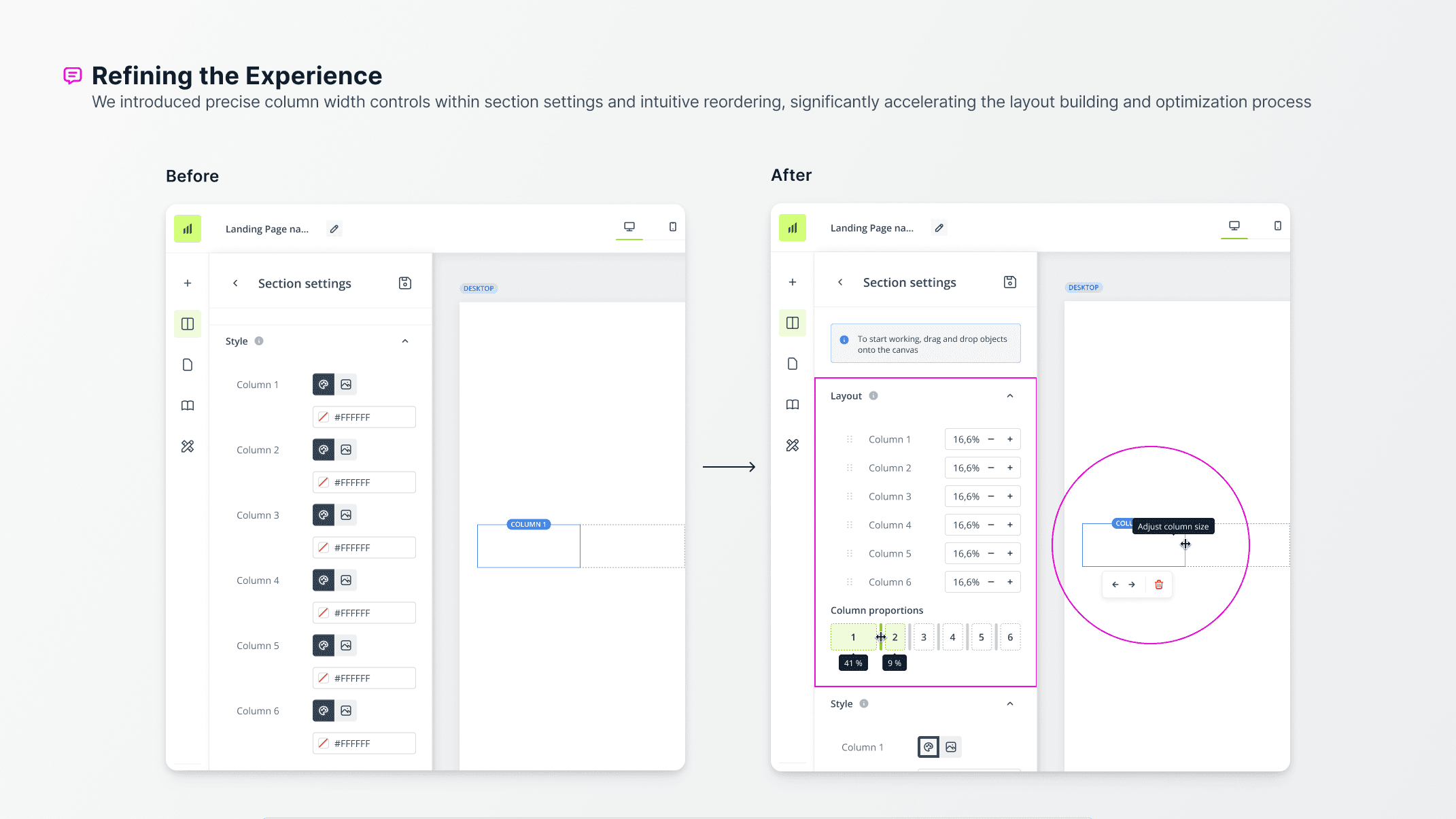
Moderated tests revealed friction in column management, interactions and label clarity.

Iteration:
Based on feedback, we redesigned the menu interactions and simplified the navigation. This increased the "Ease of Use" score significantly before the final release.

Beta Phase:
Collaborated with Customer Success to gather real-world feedback, identifying "sales-driving" features that added immediate market value.

The outcome

Measurable Impact

The Web Engagement Studio transformed the product from a collection of tools into a cohesive platform.

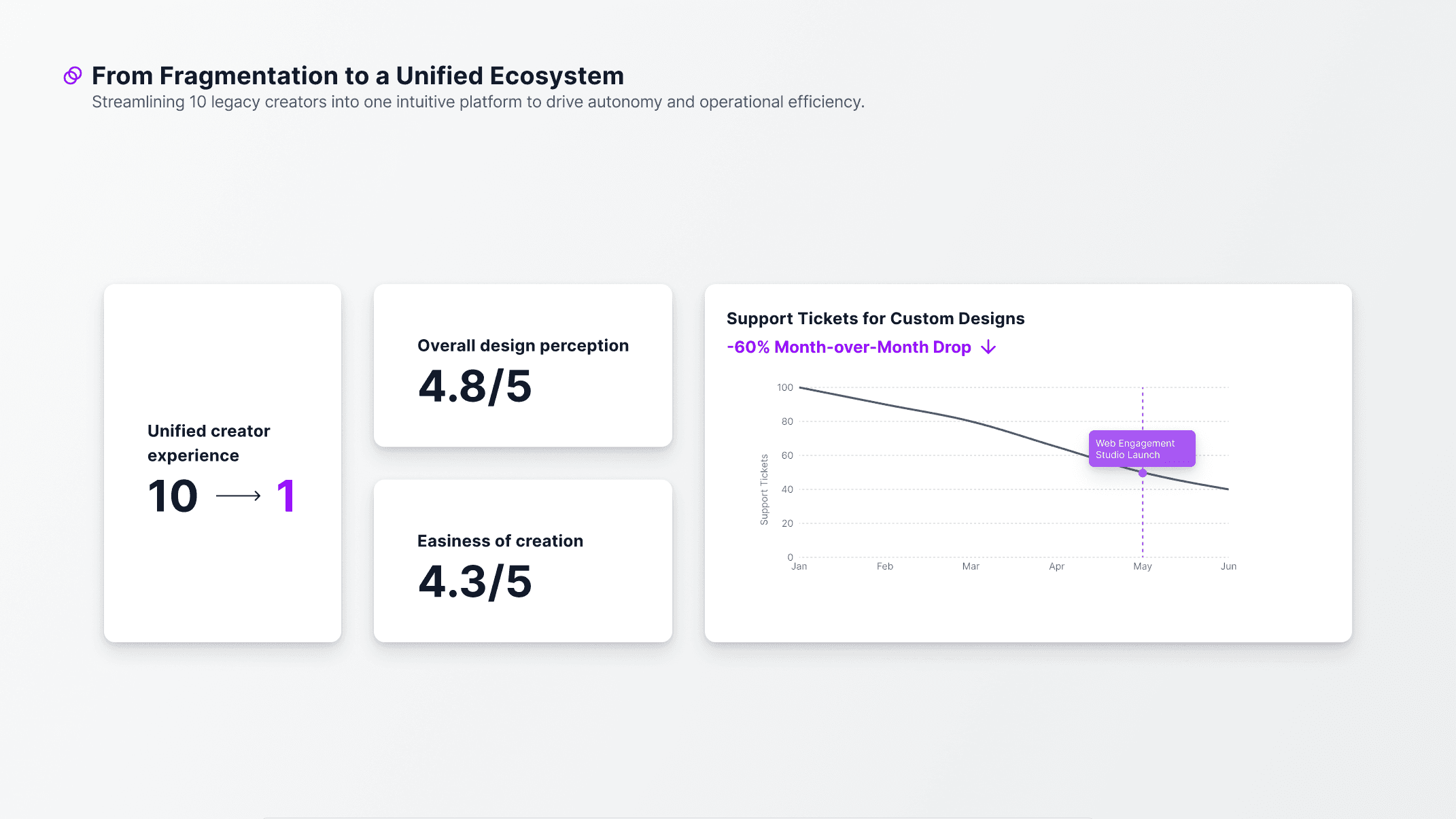
  • For Business: Successfully reduced the number of creators from 10+ to 1. Support tickets for custom designs dropped month-over-month, hitting our -60% target.

  • For Users: Achieved a 4.8/5 Clarity Rating and a 4.3/5 Ease of Use score. Users no longer had to switch contexts, leading to higher feature adoption.

  • For Development: The Design System served as the "single source of truth," reducing UI bugs and accelerating the hand-off process.

Smooth Scroll
This will hide itself!

Web Engagement Studio Unifying the Creation Experience

EXECUTIVE SUMMARY

At Salesmanago, we faced a major scalability hurdle: maintaining over 10 fragmented creators (pop-ups, landing pages, forms, etc.). This fragmentation caused significant tech debt and user confusion. As the Lead Product Designer, I spearheaded the unification of these tools into a single, powerful ecosystem: the Web Engagement Studio.

YEAR

2024-2025

ROLE

UX/UI
Product Designer

SERVICES

Product Strategy, Design Systems, Enterprise UI/UX Design

The Challenge

Tech Debt & Cognitive Overload

Business Pain:
Maintaining 10 separate infrastructures was resource-heavy and blocked the roadmap for new features. The Custom Design department was overwhelmed with basic requests because clients couldn't solve simple design needs within the legacy editors.

User Pain:
"Cognitive Overload"—users had to learn 10 different interfaces and logics. This learning curve hindered the adoption of advanced features.

The Goal: Consolidate 10 tools into 1 stable engine, reduce Custom Design tickets by 60%, and empower users to be self-sufficient.

The Process

Bridging Design & Engineering - From Chaos to Strategy

Before diving into pixels, I led a rigorous preparation phase to ensure the new Studio would be both technically sound and business-aligned.

Audit & Aggregation:
I started by aggregating all requests from the Custom Design department and analyzing client pain points. We conducted a functional audit of all 10+ legacy creators to identify overlaps, feature gaps, and essential "must-haves" for the new unified engine.

Technical & Market Research:
Together with the development team, we performed a deep technical feasibility study focusing on backward compatibility. Simultaneously, I conducted competitive research to ensure our new solution met the latest industry trends and user expectations.

The "Product Triad" Collaboration:
I worked in a core 3-person team (Product Designer, PO, and Tech Lead) to finalize the architecture. This collaboration ensured that our "Minimum Viable Plan" was balanced across design, business goals, and engineering constraints.

Iterative Design & Engineering Sync:
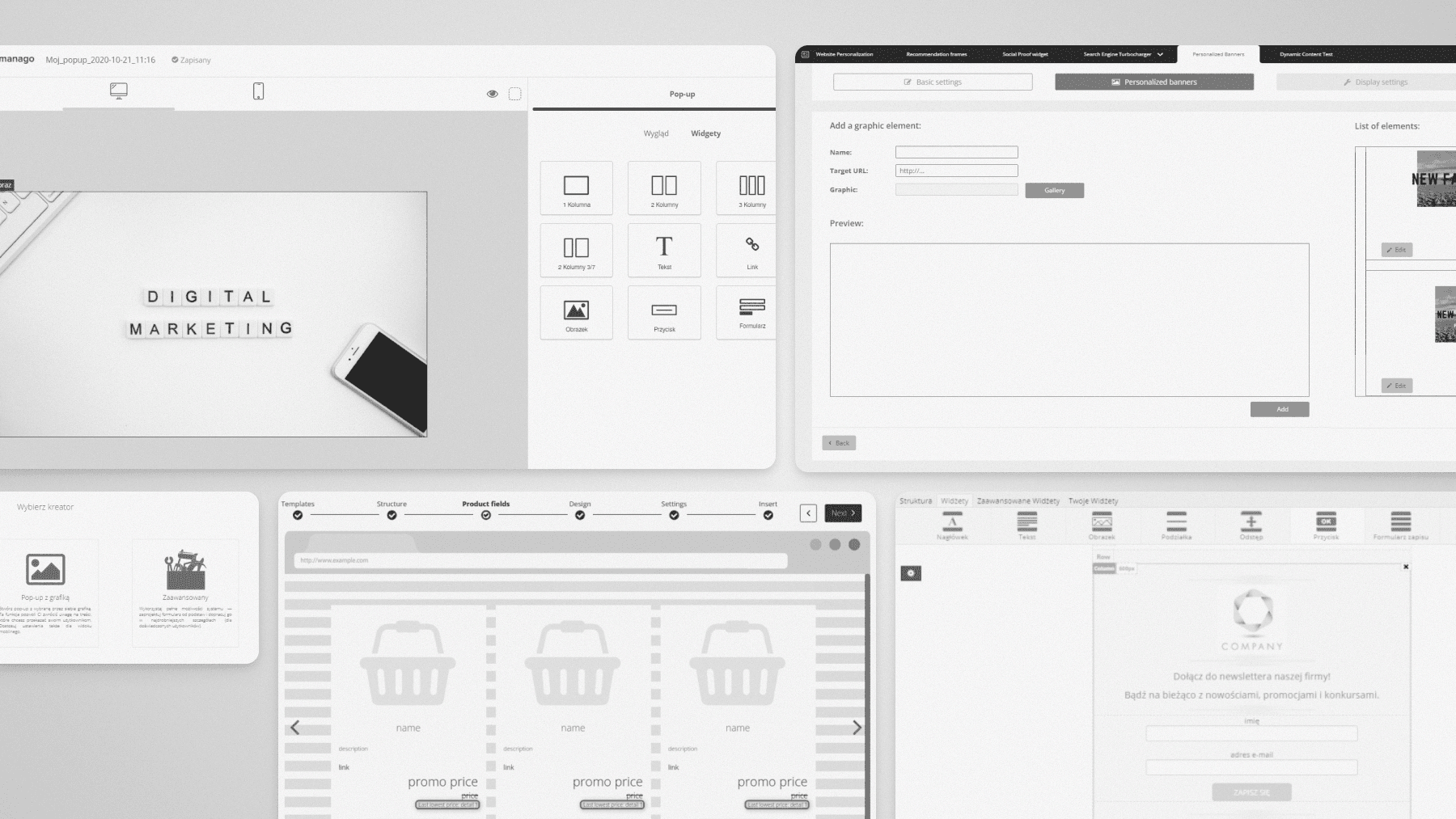
Once the architecture was approved by stakeholders, I moved to low-fidelity wireframes. Every section was developed iteratively and reviewed by the dev team to prevent technical roadblocks early on.

Design System as a Single Source of Truth:
Every component was built and synced with Storybook from day one. This technical "bridge" allowed us to maintain 100% UI consistency and significantly speed up the hand-off process.
Validation

Data-Driven Refinement

Alpha Testing:
Moderated tests revealed friction in column management, interactions and label clarity.

Iteration:
Based on feedback, we redesigned the menu interactions and simplified the navigation. This increased the "Ease of Use" score significantly before the final release.

Beta Phase:
Collaborated with Customer Success to gather real-world feedback, identifying "sales-driving" features that added immediate market value.

The outcome

Measurable Impact

The Web Engagement Studio transformed the product from a collection of tools into a cohesive platform.

  • For Business: Successfully reduced the number of creators from 10+ to 1. Support tickets for custom designs dropped month-over-month, hitting our -60% target.

  • For Users: Achieved a 4.8/5 Clarity Rating and a 4.3/5 Ease of Use score. Users no longer had to switch contexts, leading to higher feature adoption.

  • For Development: The Design System served as the "single source of truth," reducing UI bugs and accelerating the hand-off process.

Smooth Scroll
This will hide itself!

Web Engagement Studio Unifying the Creation Experience

EXECUTIVE SUMMARY

At Salesmanago, we faced a major scalability hurdle: maintaining over 10 fragmented creators (pop-ups, landing pages, forms, etc.). This fragmentation caused significant tech debt and user confusion. As the Lead Product Designer, I spearheaded the unification of these tools into a single, powerful ecosystem: the Web Engagement Studio.

YEAR

2024-2025

ROLE

UX/UI
Product Designer

SERVICES

Product Strategy, Design Systems, Enterprise UI/UX Design

The Challenge

Tech Debt & Cognitive Overload

Business Pain:
Maintaining 10 separate infrastructures was resource-heavy and blocked the roadmap for new features. The Custom Design department was overwhelmed with basic requests because clients couldn't solve simple design needs within the legacy editors.

User Pain:
"Cognitive Overload"—users had to learn 10 different interfaces and logics. This learning curve hindered the adoption of advanced features.

The Goal: Consolidate 10 tools into 1 stable engine, reduce Custom Design tickets by 60%, and empower users to be self-sufficient.

The Process

Bridging Design & Engineering - From Chaos to Strategy

Before diving into pixels, I led a rigorous preparation phase to ensure the new Studio would be both technically sound and business-aligned.

Audit & Aggregation:
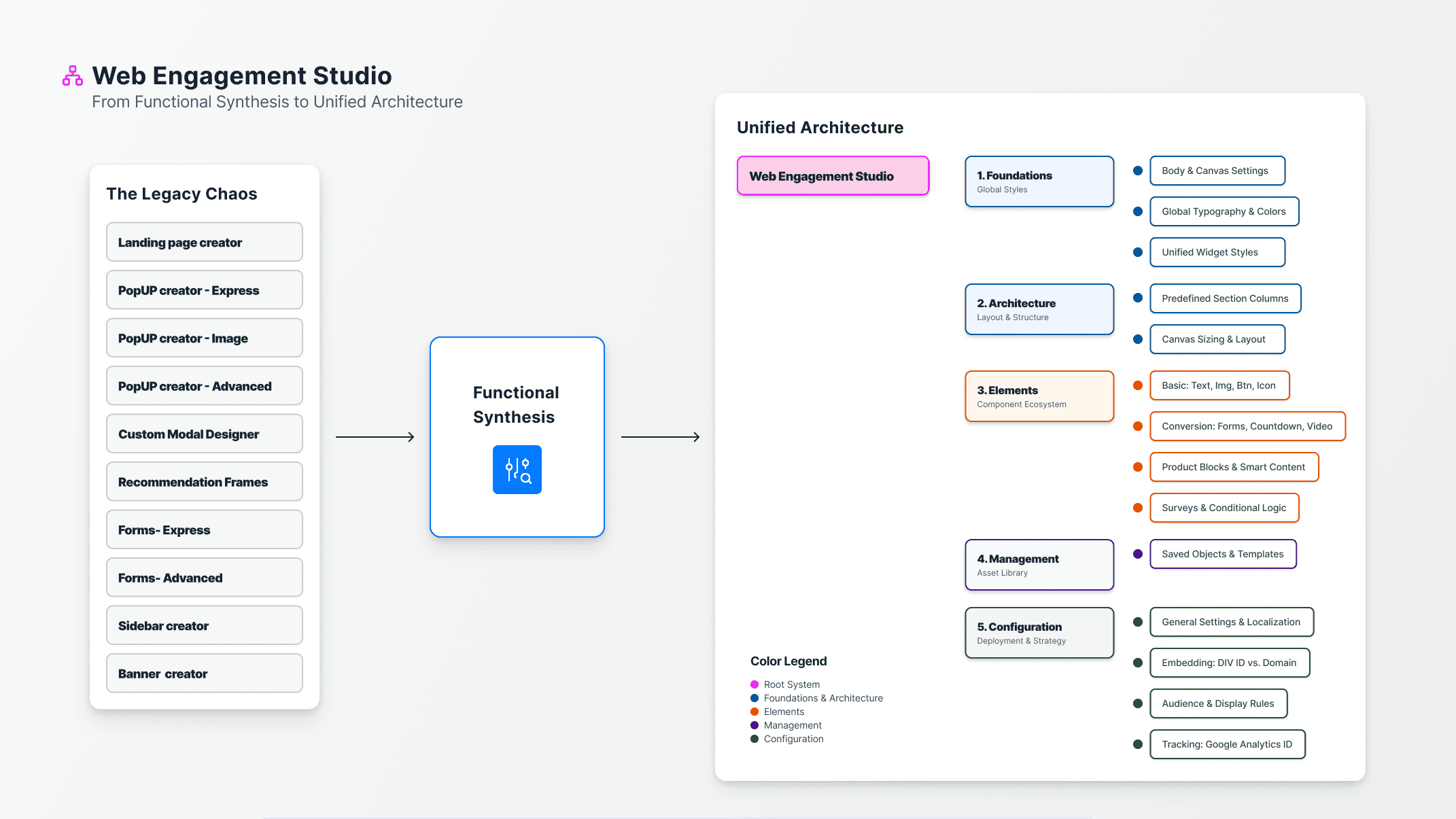
I started by aggregating all requests from the Custom Design department and analyzing client pain points. We conducted a functional audit of all 10+ legacy creators to identify overlaps, feature gaps, and essential "must-haves" for the new unified engine.

Technical & Market Research:
Together with the development team, we performed a deep technical feasibility study focusing on backward compatibility. Simultaneously, I conducted competitive research to ensure our new solution met the latest industry trends and user expectations.

The "Product Triad" Collaboration:
I worked in a core 3-person team (Product Designer, PO, and Tech Lead) to finalize the architecture. This collaboration ensured that our "Minimum Viable Plan" was balanced across design, business goals, and engineering constraints.

Iterative Design & Engineering Sync:
Once the architecture was approved by stakeholders, I moved to low-fidelity wireframes. Every section was developed iteratively and reviewed by the dev team to prevent technical roadblocks early on.

Design System as a Single Source of Truth:
Every component was built and synced with Storybook from day one. This technical "bridge" allowed us to maintain 100% UI consistency and significantly speed up the hand-off process.
Validation

Data-Driven Refinement

Alpha Testing:
Moderated tests revealed friction in column management, interactions and label clarity.

Iteration:
Based on feedback, we redesigned the menu interactions and simplified the navigation. This increased the "Ease of Use" score significantly before the final release.

Beta Phase:
Collaborated with Customer Success to gather real-world feedback, identifying "sales-driving" features that added immediate market value.

The outcome

Measurable Impact

The Web Engagement Studio transformed the product from a collection of tools into a cohesive platform.

  • For Business: Successfully reduced the number of creators from 10+ to 1. Support tickets for custom designs dropped month-over-month, hitting our -60% target.

  • For Users: Achieved a 4.8/5 Clarity Rating and a 4.3/5 Ease of Use score. Users no longer had to switch contexts, leading to higher feature adoption.

  • For Development: The Design System served as the "single source of truth," reducing UI bugs and accelerating the hand-off process.

Smooth Scroll
This will hide itself!